
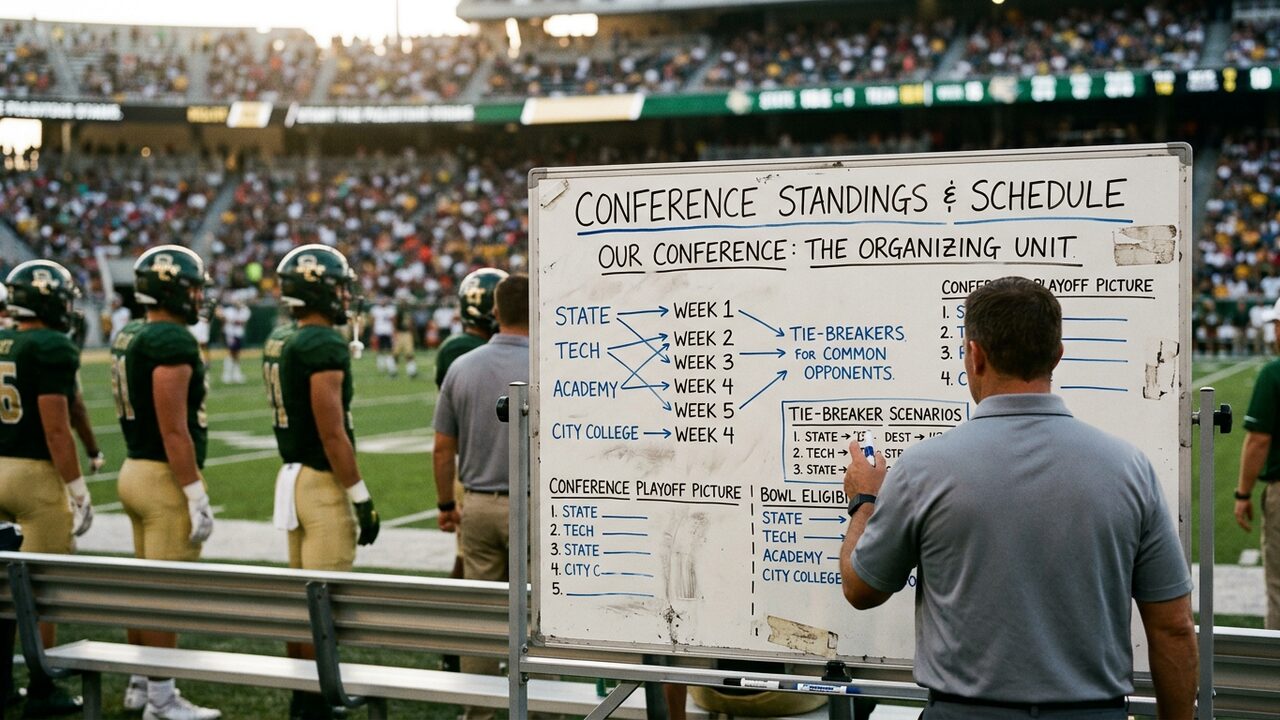
A league of leagues
It helps to picture college football as a collection of regional competitions that occasionally intersect, rather than as one flat national table. A team's conference schedule supplies most of its meaningful games, its natural rivals and the yardstick by which its season is judged before any national conversation begins. This is closer to how many domestic football or rugby competitions once organised regional divisions than to a single unified professional league, and it explains why a team's conference identity can matter as much as its overall record.
Identity that predates ranking
Conference membership carries history, television relationships and geography that a ranking table cannot capture. Two programmes can be separated by a few positions in a national poll yet feel entirely different in stature because of who they play every year and what those games have meant for decades. That local texture is not decoration; it is a large part of why the regular season retains meaning even for teams with little realistic path to a national prize, since a strong conference season is its own achievement.
What realignment actually changes
Recent conference realignment has stretched some leagues across much greater distances and reshuffled long-standing rivalries, and that is a real cost to travel and tradition. What it has not changed is the underlying logic: the conference, not the sport as a whole, remains the primary unit a fan roots for week to week. Any attempt to understand a season's shape should start there, working outward from conference contests toward the smaller number of games that cross conference lines.