
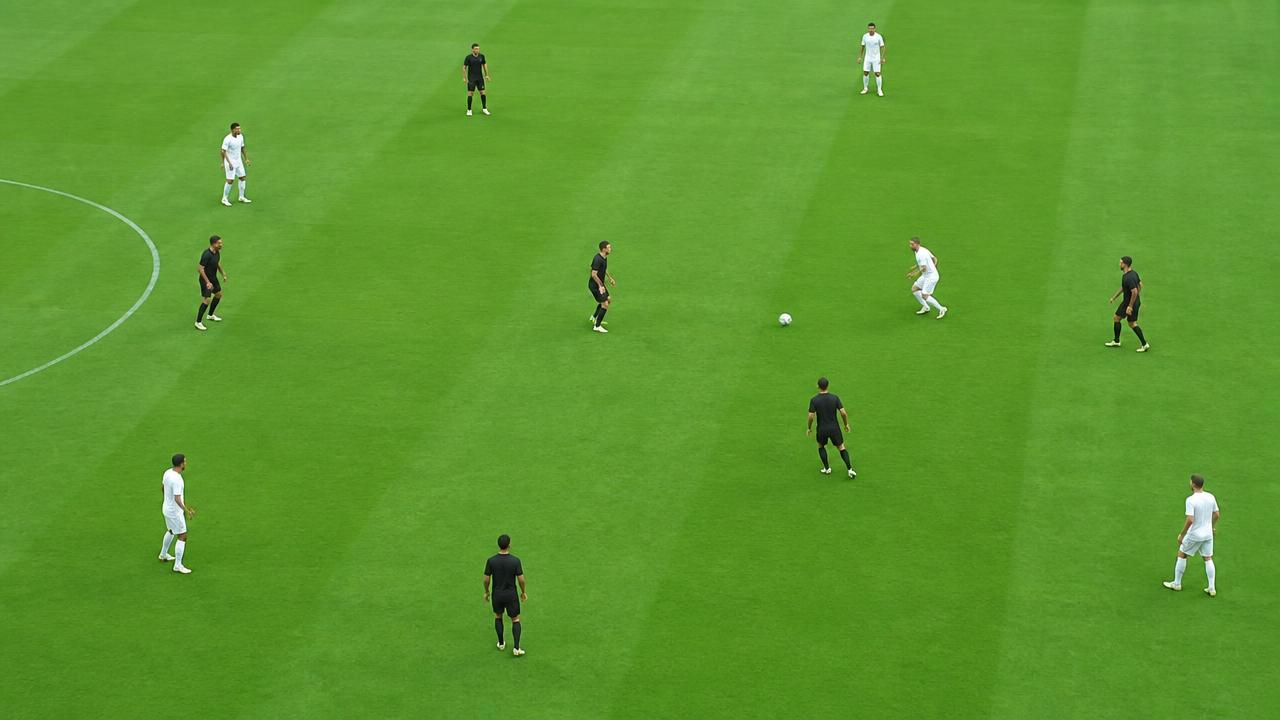
Occupying space before receiving it
The identifiable feature of a Dutch-coached team is not that it passes a lot but that its players stand in specific places before the ball arrives: one man per vertical channel, staggered heights so no two teammates are on the same line, and a deliberate distance between them. That spacing is what makes a press difficult, because every defender who moves towards the ball opens a passing lane behind him.
This is coachable in a way that individual technique is not, which is why teams with modest squads can still look organised in possession. It is also why those teams collapse so visibly when two players drift into the same area: the structure does the work, and without it the passing looks ordinary.
Possession as protection
A high defensive line is only safe if the opponent rarely has the ball in a position to use the space behind it. Keeping possession is therefore part of the defensive plan, not an alternative to it, and the moments to watch are the transitions: how quickly the nearest two players counter-press when the ball is lost, and whether the line steps up or drops as they do.
When a possession side concedes a bad goal, the cause is usually those two seconds rather than anything the defenders did afterwards.
Where the approach is exposed
The uncomfortable opponent is one that declines the contest: a deep block with no interest in pressing, happy to let the ball be circulated in front of it and to attack twice a half. Against that, spacing has nothing to pull apart, and the possession team has to break a compact defence with combination play in small areas, which is a harder skill than the one it has drilled.
European nights tend to expose the same thing in a different way. Against opponents who press well and counter quickly, the structure has to hold at higher speed, and that is where the difference between a well-coached idea and a well-resourced squad shows.