
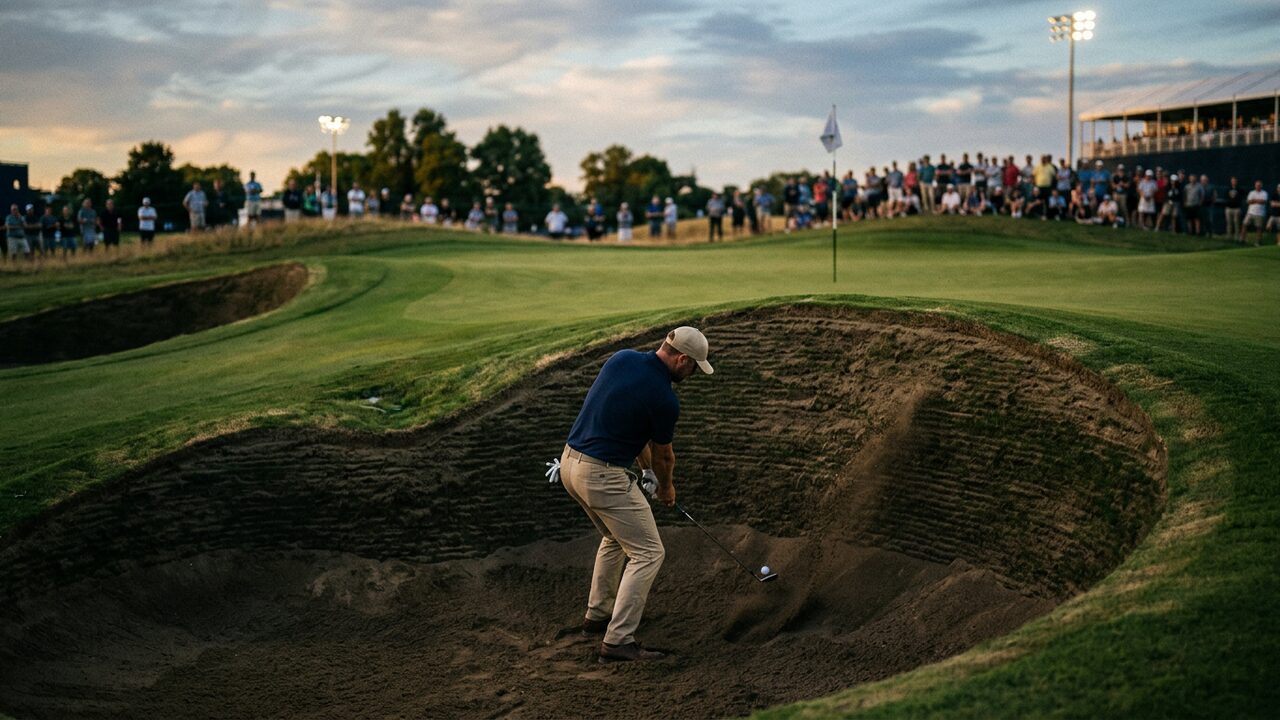
Placement is an argument about strategy
Architects position bunkers to punish a specific decision, usually the tempting line that would otherwise offer the biggest reward, such as cutting the corner of a dogleg or attacking a tucked pin directly. A bunker placed short and right of a green, for example, is often there specifically to discourage the direct approach and push players toward a longer, safer route, which makes the hazard part of the hole's argument rather than simple punishment for inaccuracy.
When the lip becomes the real hazard
A steep-faced bunker can force a purely defensive shot regardless of how well it is struck, because escaping over a high lip demands a lofted club that sacrifices distance no matter the player's skill. This turns some bunkers into strategic hazards that cost a hole rather than merely a stroke, and it is why players will sometimes choose a longer route off the tee purely to avoid a specific bunker's lip rather than the sand itself.
Sand is not uniform either
The density, depth and texture of the sand itself changes how a ball sits once it lands, and firmer or shallower sand behaves quite differently from soft, deep sand even in bunkers that look identical from a distance. Course maintenance choices around sand are therefore another quiet difficulty lever, changing how predictable bunker shots are for an entire field without altering the visible shape or placement of a single hazard.