
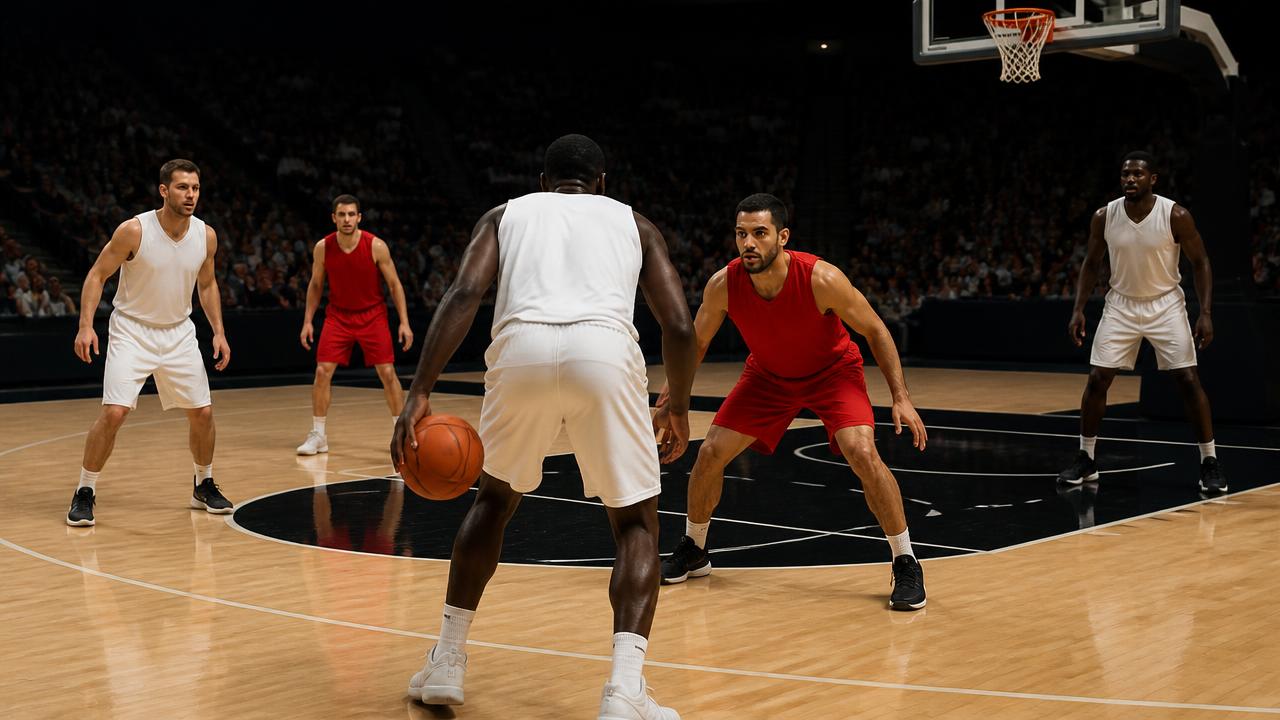
The five traditional positions
Basketball inherited a numbering system from an era when players stood in fixed places. The point guard organised the attack from the top of the floor. The shooting guard scored from the perimeter. The small forward covered the wing, the power forward worked closer to the basket, and the centre lived under it, rebounding and finishing.
That description was accurate for decades and is now barely useful. Broadcasters still use the labels because they are convenient shorthand, but a modern lineup often contains three players who can all bring the ball up and two who can all shoot from distance. What changed was not the positions but the value of space.
How the three-point line rewrote the roles
Once a shot from distance became worth fifty percent more than a shot from inside, every player who could not take it became a defensive problem for their own team. A big who stands near the basket without a jump shot pulls his defender into the area his teammates want to drive through. The same player, standing at the arc, drags that defender out and opens the floor.
So the requirements changed. Bigs learned to shoot or to switch onto smaller players. Guards were asked to rebound. The tallest player on the floor is now often the second or third best passer on his team, because a big who can pass out of the short roll breaks the standard defensive answer to a pick and roll.
The label that survived best is point guard, and even that has been diluted. Many teams now run their offence through whichever player draws the most defensive attention, regardless of height, and let the nominal point guard play off the ball.
The roles coaches actually assign
Watch a rotation rather than a starting five and the real structure appears. There is a primary creator who is trusted with the ball when a possession breaks down. There are floor spacers whose job is to stand still in the right place and punish a defence for helping. There is usually one defensive specialist who takes the opponent's best perimeter scorer and is accepted as a limited scorer in return.
There is a rim protector, whose presence changes the shot chart of the entire opposing team, and a connector — a player who is not the best at anything but makes the correct pass quickly, which is worth more over a season than it sounds.
Closing lineups are where these roles become visible. In the last five minutes coaches abandon positional balance entirely and put the five players on the floor who can execute the specific job the scoreline requires, which is often a lineup with no traditional centre at all.