
Two different kinds of number
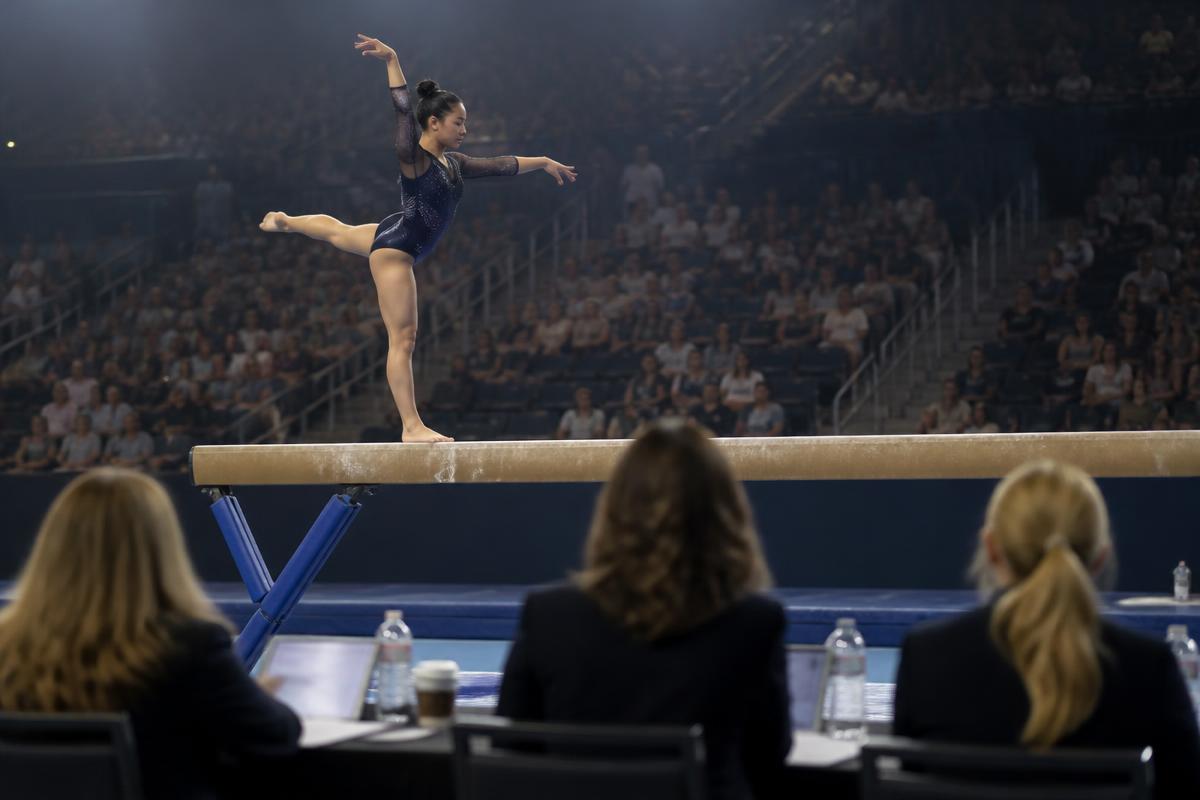
A swimming result is a measurement: a clock records a time and the ordering follows from it. A gymnastics result is an evaluation: judges assess what was attempted and how well it was performed, and the ordering follows from their scores. Both produce a decimal number on a screen, which is exactly why they get treated as equivalent when they are not.
Measured sports can be wrong only in a narrow band. Timing equipment resolves to hundredths or thousandths, and when two competitors fall inside that band the sport either declares a tie or uses a photo finish and image analysis to separate them. Anything below the equipment's resolution is genuinely unknowable, and the rules say so rather than pretending otherwise.
How judged scoring is built
Contemporary judged sports mostly split the score in two. A difficulty component describes what the athlete attempted, built from a published catalogue of elements and their values. An execution component starts from a maximum and subtracts deductions for errors — a bent knee, a step on landing, an incomplete rotation. Adding them gives a total in which ambition and cleanliness are visible separately.
That split changes the strategy of the event. An athlete can win with a smaller routine performed almost perfectly, or with a much harder one that leaks deductions, and coaches choose between those paths deliberately. It also makes disagreement more legible: an argument about a score is usually an argument about one component, not about the whole performance.
Panels are constructed to limit individual influence, typically by discarding the highest and lowest marks and averaging the rest, and by separating difficulty determination from execution judging. Combat sports use a different structure again, with rounds scored by several officials and no cumulative difficulty value at all.
Appeals, inquiries and what can be changed
In judged sports the coach usually has a formal inquiry route into the difficulty score — the objectively checkable part — and little or no route into execution deductions, which are treated as judgement. In measured sports protests concern the conditions of the race rather than the number: a false start, an obstruction, a lane infringement, an equipment failure.
This is why the two families of sport produce different controversies. Judged sports argue about whether an evaluation was fair; measured sports argue about whether the contest was clean and correctly conducted. Both arguments are legitimate, and both are decided by the sport's own federation under its own published rules.
For a reader, the practical takeaway is to check what kind of number you are looking at before comparing performances across sports — and to be sceptical of any Olympic table that adds them together as though they were the same currency.