
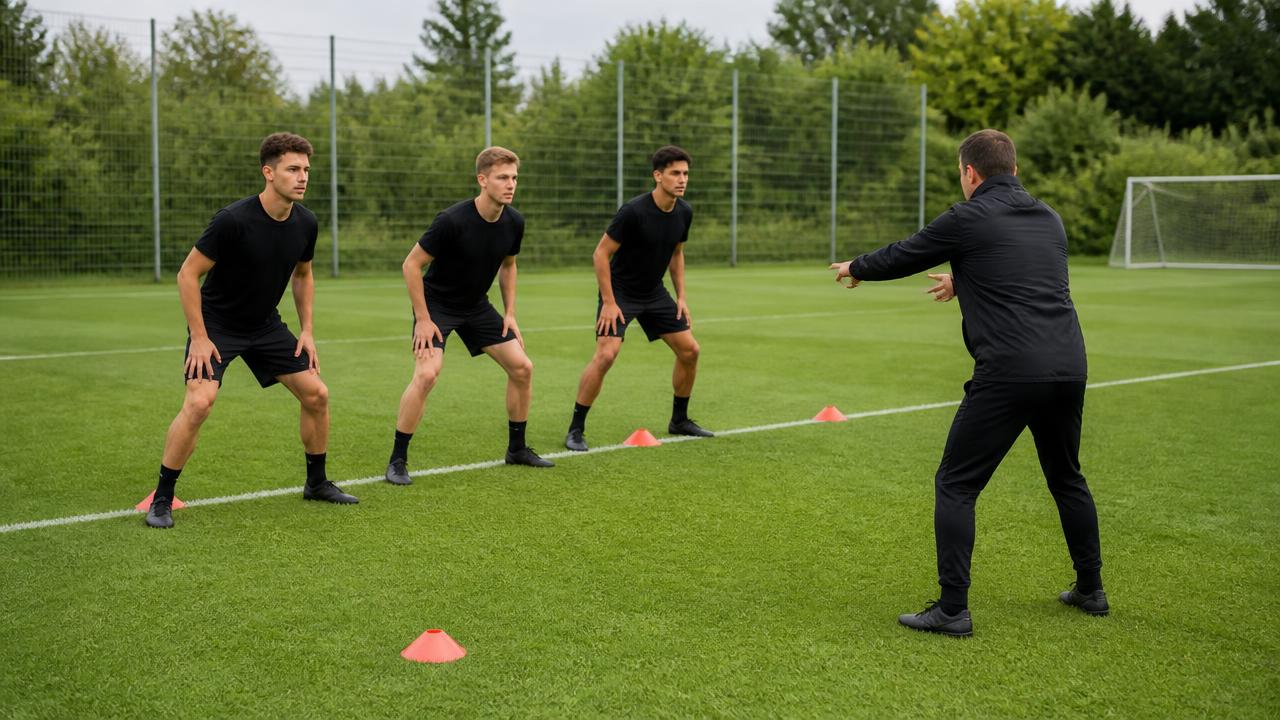
Three defenders, three jobs
In a well-taught back three the middle defender is the organiser: he holds the line, communicates, and rarely leaves his position. The two outside him are hybrids, expected to defend a wide channel, follow a forward into midfield when necessary, and step out with the ball to break a press. Coaches who recruit for this system look for defenders comfortable being pulled out of a comfortable shape.
That distribution of duties is the reason the same formation can look conservative at one club and aggressive at another. Nothing about three centre-backs is inherently defensive; what matters is how far the outside two are allowed to travel.
The spare man in build-up
Against two forwards, a back three gives the team an extra body in the first phase, which is the practical reason so many coaches use it. The spare defender can carry the ball forward until an opponent commits to him, and every time someone does, a pass opens elsewhere. Watch for the moment a centre-back crosses the halfway line unchallenged: that is the system working exactly as designed.
The cost is midfield numbers. With three defenders and two wide players high up the pitch, the centre of the pitch can be thin, so the midfielders in front of the line have to be disciplined about spacing rather than adventurous.
How it breaks
The usual failure is confusion in wide areas. If the wing-back has pushed forward and the wide centre-back is unsure whether to follow the opposing winger or hold the line, the space between them becomes the easiest pass on the pitch. Teams that defend this well have an explicit rule, and you can hear it from the stands, because someone is shouting the same instruction every time.
The second failure is a slow middle defender against a direct team. A back three tolerates one defender who cannot sprint only if the line sits deep enough to make that irrelevant, and few coaches want to sit that deep.