
A different court, a different priority
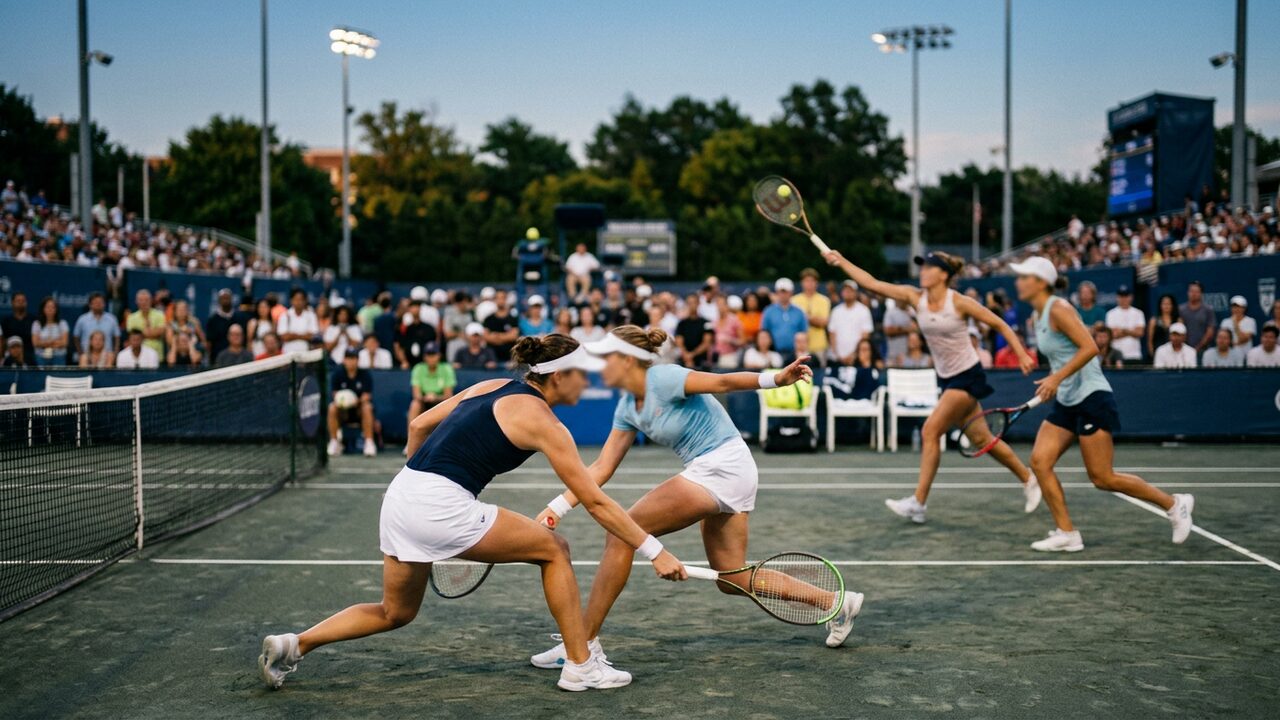
Doubles is played on a wider court but with two players sharing it, which in practice means the net is contested space far more aggressively than in singles, since a shot down the middle can now be intercepted by either partner. This pushes the sport's centre of gravity toward the net and away from the long baseline rallies that define most singles tactics, rewarding reflexes, volleying technique and quick decision-making over the sustained power and endurance that a singles baseline battle demands.
Poaching and the coordination it requires
One of doubles' defining tactics is poaching, where the player at the net crosses to intercept a shot intended for their partner's side, relying on a signal agreed before the point to avoid both players colliding or leaving the same gap uncovered. This kind of prearranged coordination has no real equivalent in singles, where a player only ever has to manage their own positioning, and it means doubles success depends partly on a functioning partnership rather than on either player's individual ability alone.
Why singles success does not automatically transfer
Because of these differences, elite singles players are not automatically elite doubles players, and specialists exist who make careers almost entirely in the doubles game despite lacking the physical power associated with singles success. The skills that decide doubles matches, sharp reactions, precise volleys and reliable communication, overlap only partially with the skills that decide singles ones, which is why the two draws at the same tournament often crown very different kinds of champion.