
From stepping in to rotating through
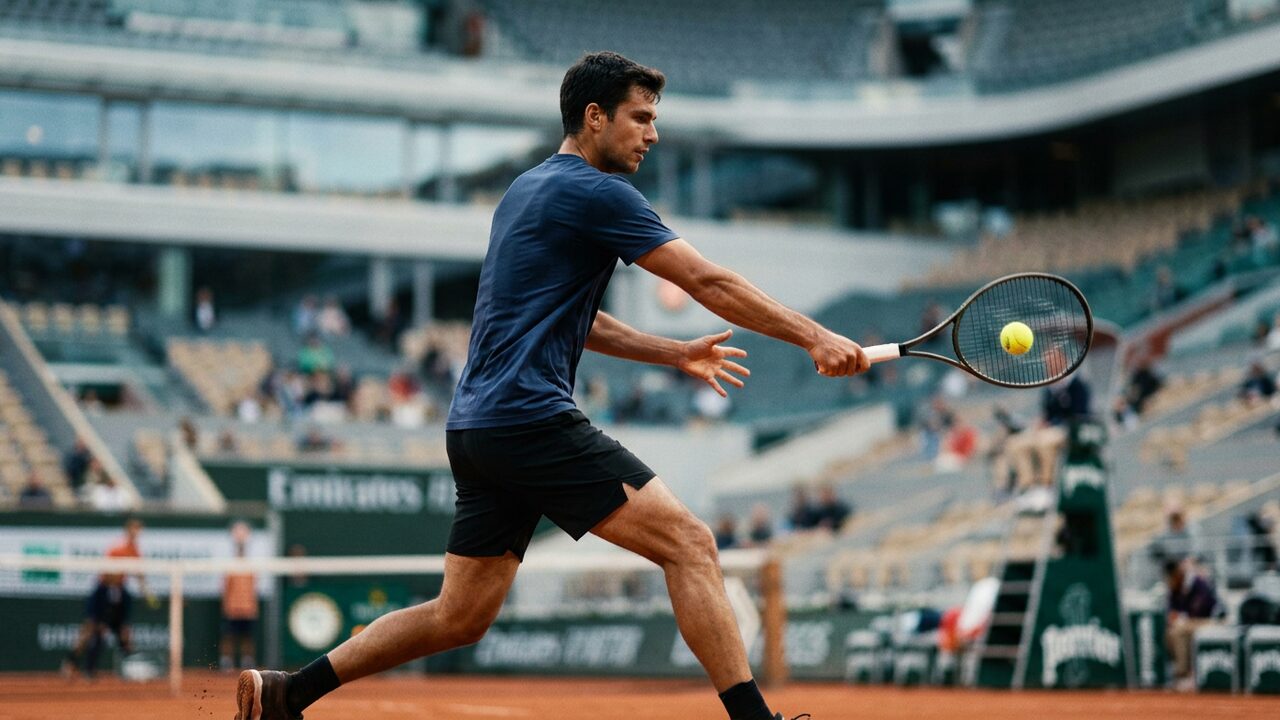
Older forehand technique typically involved stepping the front foot toward the net and swinging in a relatively flat, linear path, closer to the mechanics of a golf swing. The modern version instead has most players stand with both feet roughly parallel to the baseline, an open stance, and generate the shot by rotating the hips and torso rather than by stepping forward. The ball is still struck with full commitment, but the source of the power has moved from a forward step to a turning motion, which changes almost every other part of the stroke that follows from it.
Where the power actually comes from
Because the stance is open, the arm and racket alone cannot generate modern forehand pace; the energy is built lower down, in the loading and unwinding of the hips and core, and transferred up through the shoulder to the arm at the last possible moment. This kinetic chain is what allows players to generate heavy topspin and pace simultaneously, since the racket can accelerate through a longer arc without needing a big forward stride to create that acceleration.
A stance built for recovery too
The open stance carries a second, less discussed benefit: because the front foot never steps deep into the court, the body is already positioned to push back toward the centre for the next shot, rather than needing to first recover a forward-committed stance. In a sport where rallies are frequently decided by who reaches the following ball in better balance, this recovery advantage is arguably as important to the modern forehand's dominance as the extra topspin it generates.