
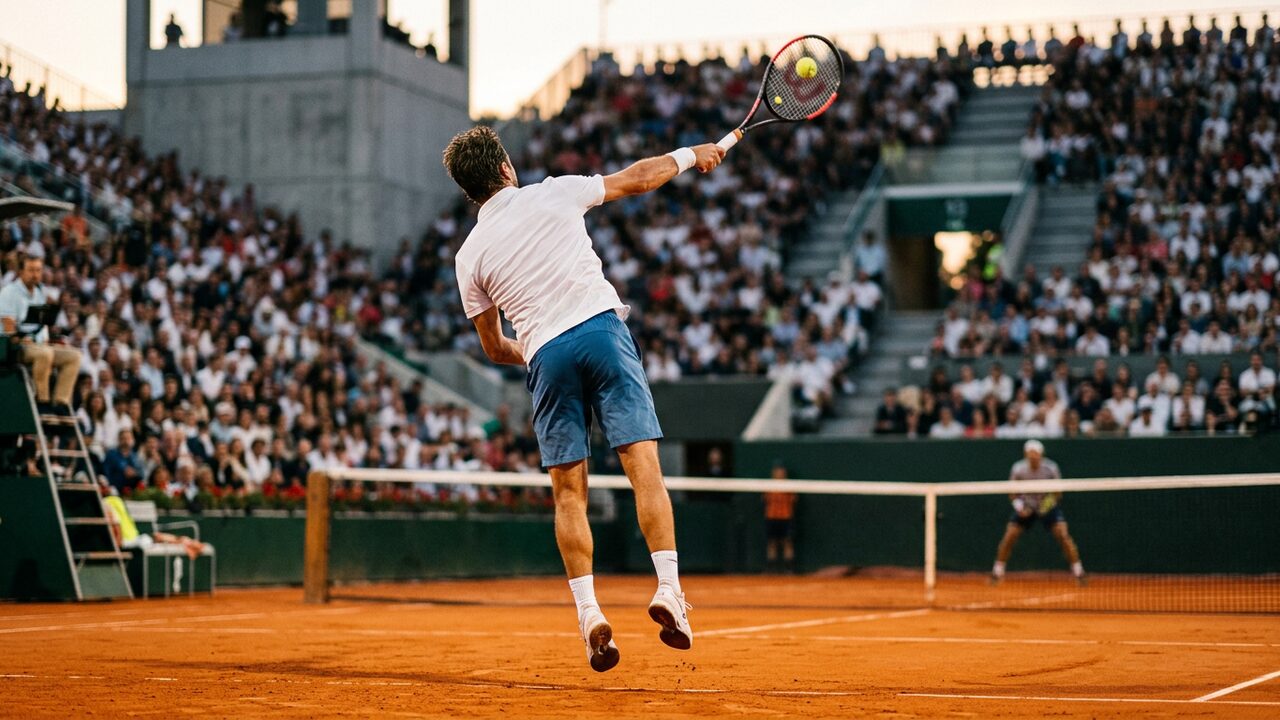
A shot played in isolation
Every other shot in tennis is a response: a player reacts to pace, spin and placement chosen by someone else. The serve is the exception. The server decides where to stand, where to aim, how much spin to impart and when to begin, all before the returner has any information to react to beyond a stance and a toss. That head start, repeated every second point of a match, is a structural advantage baked into the rules rather than a product of any individual player's skill, and it is the reason serving well is a floor under a player's results rather than a bonus on top of them.
Why holding serve is the baseline
Because of that built-in edge, holding serve is treated across the sport as the expected outcome rather than a success worth celebrating. Commentary and statistics both reflect this: a hold is unremarkable, while a break is the event that actually moves a set forward. This asymmetry shapes tactics directly, since a player behind on the scoreboard is usually looking for the one or two return points per set where the server's advantage can plausibly be neutralised, rather than trying to out-hit the server on serve.
What breaking a serve requires
Because the server's edge is structural, breaking it usually needs either a return struck early enough to remove the server's time advantage, or enough consistency to survive long enough that a single loose service game arrives on its own. Neither approach fights the advantage directly; both work around it. This is also why a single break can be decisive in a way rare in other sports that use continuous scoring: it is not one point among many but the removal of the one game in a set where the outcome was not assumed in advance.