
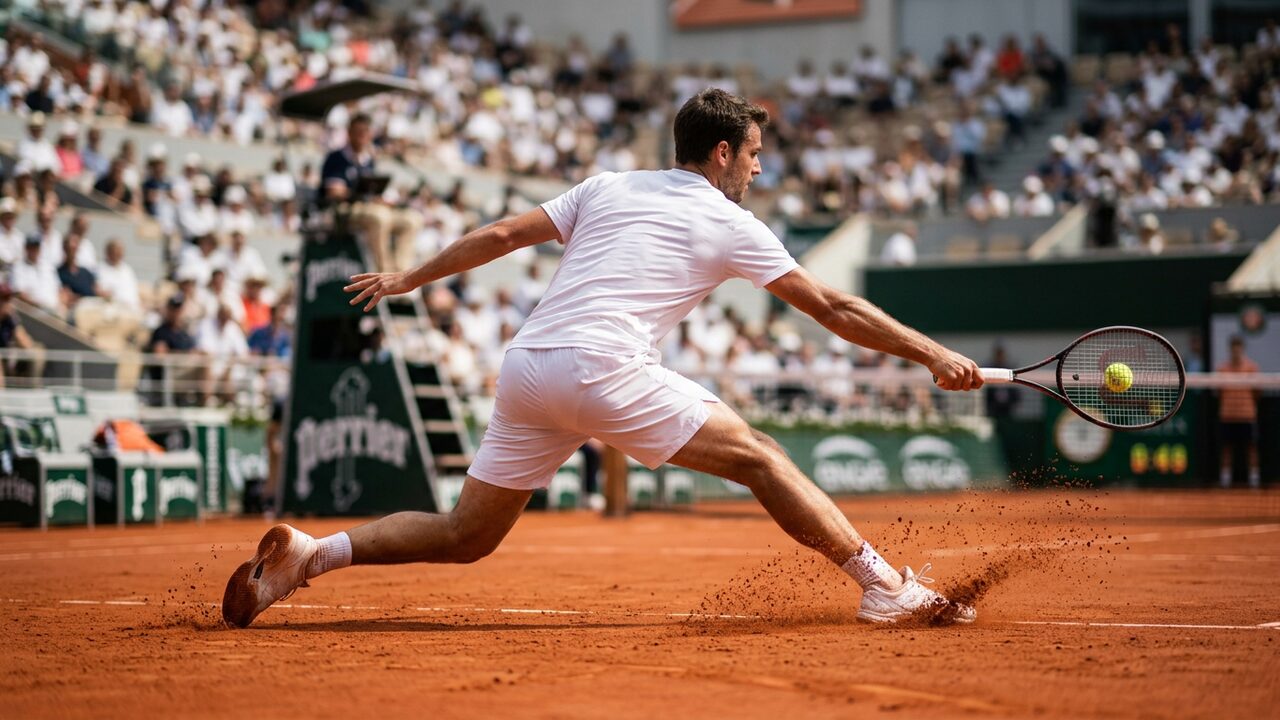
Why clay allows it and other surfaces do not
The loose top layer of clay lets a shoe slide a controlled distance before gripping again, whereas grass and hard courts offer either too little cushioning or too much fixed grip for the same motion to be safe. This is a direct extension of the surface physics discussed elsewhere: the same friction properties that slow the ball also allow a player's foot to decelerate gradually rather than stopping abruptly, converting what would be a jarring stop on a hard court into a smooth, continuous approach to the ball.
A trained motion, not an instinct
Because the slide has to be timed to arrive exactly as the racket reaches the ball, it is trained explicitly rather than picked up naturally, and players raised primarily on hard courts often need years of dedicated clay-season work to slide reliably under match pressure. Mistiming it produces either an unbalanced shot or a fall, which is why commentators can usually tell within a few points of a clay match whether a player grew up on the surface.
Reach without raw speed
The practical payoff is coverage: a player who slides well can reach balls a step further away than their raw sprint speed would suggest, because the slide extends the final stride into the shot rather than requiring a full stop and reset. This is one reason players who are not the fastest in a straight line can still be excellent defenders on clay, and why some quick hard-court movers look comparatively restricted the first time they play a full clay season.