
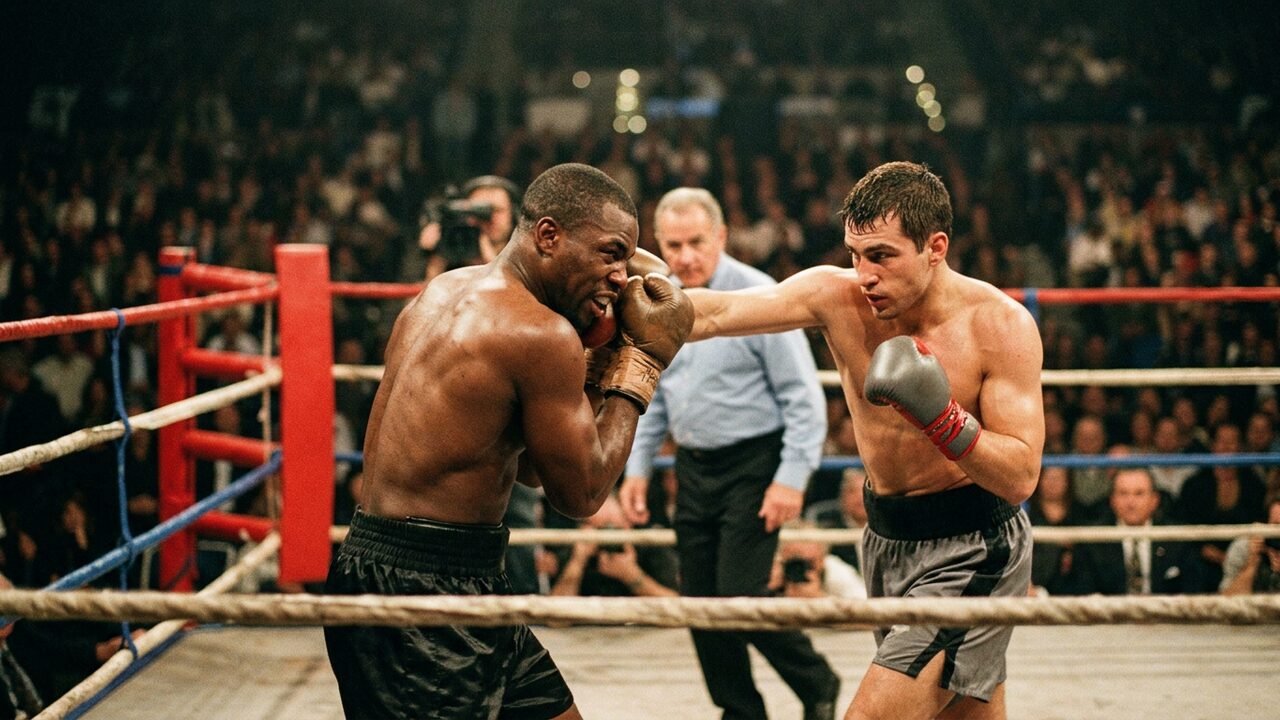
Pressure needs commitment
A pressure fighter's advantage comes from relentless forward movement that eventually corners an opponent, but sustaining that pressure requires committing weight forward on nearly every step. That commitment is unavoidable; it is the source of the pressure fighter's power and the reason they are dangerous. It is also, unavoidably, a moment of reduced balance and readiness, and a skilled opponent watching for that moment has something concrete to time.
Punishing the approach, not the attack
Counterpunchers rarely try to out-brawl a pressure fighter directly; instead they wait for the instant of forward commitment and land during it, when the pressure fighter is least able to adjust or defend. This means the counterpuncher's success has less to do with speed than with patience and accurate reading of an opponent's rhythm, since throwing too early loses the advantage of the opponent's compromised balance and throwing too late means eating the punch first.
A contest over tempo
What looks like a distance battle is often really a tempo battle: the pressure fighter wants a fast, continuous pace that never lets the counterpuncher settle, while the counterpuncher wants pauses that let them choose the moment of engagement. Fights between these styles are frequently decided by whichever fighter manages to impose their preferred tempo for longer stretches, which is why such matchups can look tense and low-output even when both fighters are highly skilled.