
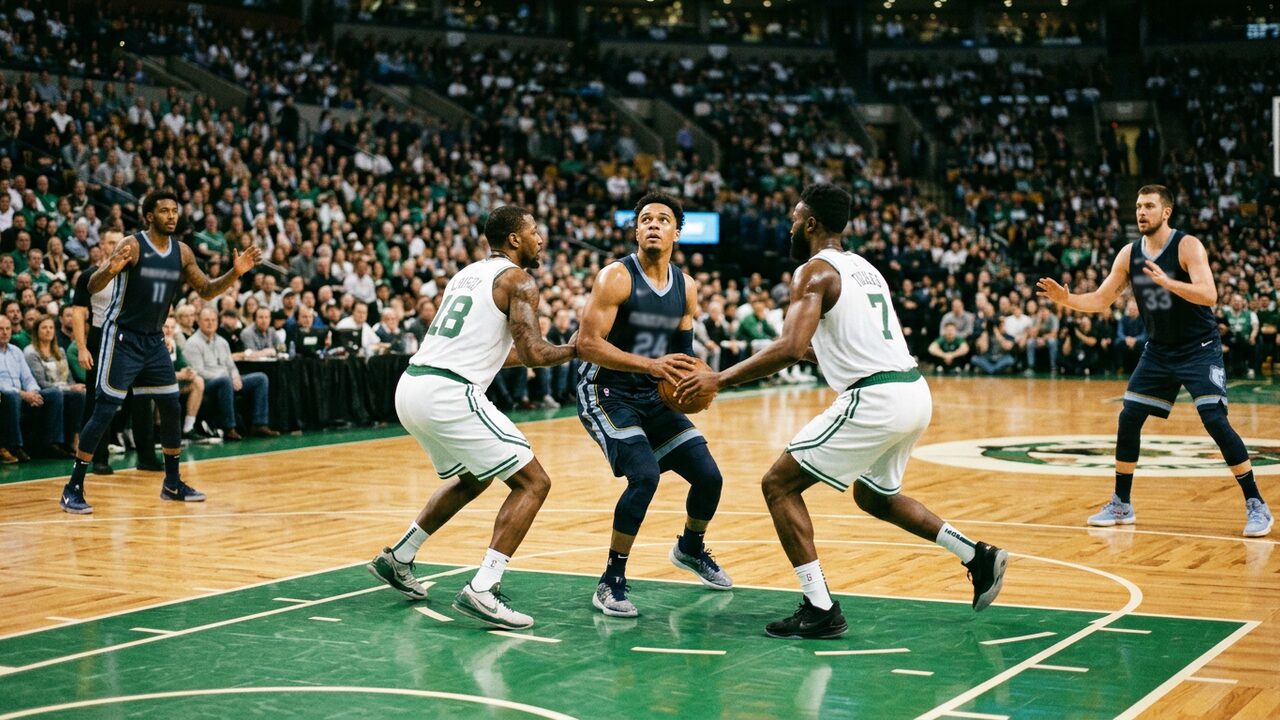
A shot that moved the walls
The obvious effect of the three-point line is arithmetic: a shot worth fifty per cent more than a two only has to be made two-thirds as often to be worth the same. Teams took decades to trust that arithmetic, and the story of the last generation of basketball is largely the story of that trust arriving. But the arithmetic is not the interesting part. The interesting part is what it did to the floor.
Before the line was taken seriously, a player without the ball had little reason to stand twenty-five feet from the basket. Now they have every reason, and a defender has to follow them out there. Each shooter who stands beyond the arc drags one defender with them, and each defender who leaves the paint takes away a body from the area where the highest-percentage shots are taken. Spacing is therefore not a shooting statistic. It is a way of emptying the middle of the floor by threat alone.
This is why teams will play a limited shooter who is respected over a better all-round player who is not. The shot does not need to be taken. It only needs to be plausible enough that the defender cannot help off it.
The corner is not a preference, it is geometry
The arc is not a perfect circle. It flattens near the sidelines, so a shot from the corner is taken from meaningfully closer to the rim than one from the top of the key while paying exactly the same three points. That single geometric quirk explains a great deal of modern positioning: offences will station a player in each corner and leave them there, and defences will treat corner help as the last resort rather than the first.
It also explains why a drive toward the baseline is more dangerous than it looks. Once the defence collapses on the ball, the nearest shooter is standing in the cheapest three on the floor, and the pass is short and straight. Teams that are good at this do not need brilliance; they need a driver who is willing to give the ball up and a corner shooter who does not drift.
The counter is to refuse to help at all and let the drive finish. Doing so is a coherent choice, not a mistake, and the best defences make it deliberately against certain opponents. What they are saying is that two points at the rim cost them less than three from the corner.
What defences give up to take spacing away
Every defensive response to spacing is a trade. Switching everything keeps a body attached to every shooter, but it hands the offence a mismatch somewhere and invites it to hunt that mismatch for as long as the shot clock allows. Dropping a big man into the paint protects the rim but concedes the pull-up jumper above the screen. Aggressive double-teams take the ball out of the best player's hands and accept that the pass will find someone open on the weak side.
None of these is a solution, and that is the point of the analysis: there is no arrangement of five defenders that covers a well-spaced floor. Coaches are choosing which shot they can live with, and that choice is what a viewer is actually watching in a close fourth quarter.
The tactical layer that follows from this is the one most worth learning. Once you can see which shot a defence has decided to concede, the rest of the possession becomes legible — the screens are being set to force that concession, and the offence is not improvising so much as walking the defence toward a decision it has already made.
Where the argument goes next
The honest limitation of any spacing argument is that it describes a tendency, not a law. Teams built around size and physical pressure keep proving that the trend has counter-currents, and rule interpretations around contact can move the balance considerably without anyone changing tactics at all.
What is stable is the underlying logic: as long as a shot from outside is worth more than a shot inside, the floor will be organised around the threat of it, and defences will keep paying somewhere for whatever they take away. Arena's NBA guides cover the mechanics behind that logic — the rules, the positional roles that spacing created and the statistics that measure it — and they are the natural next read.