
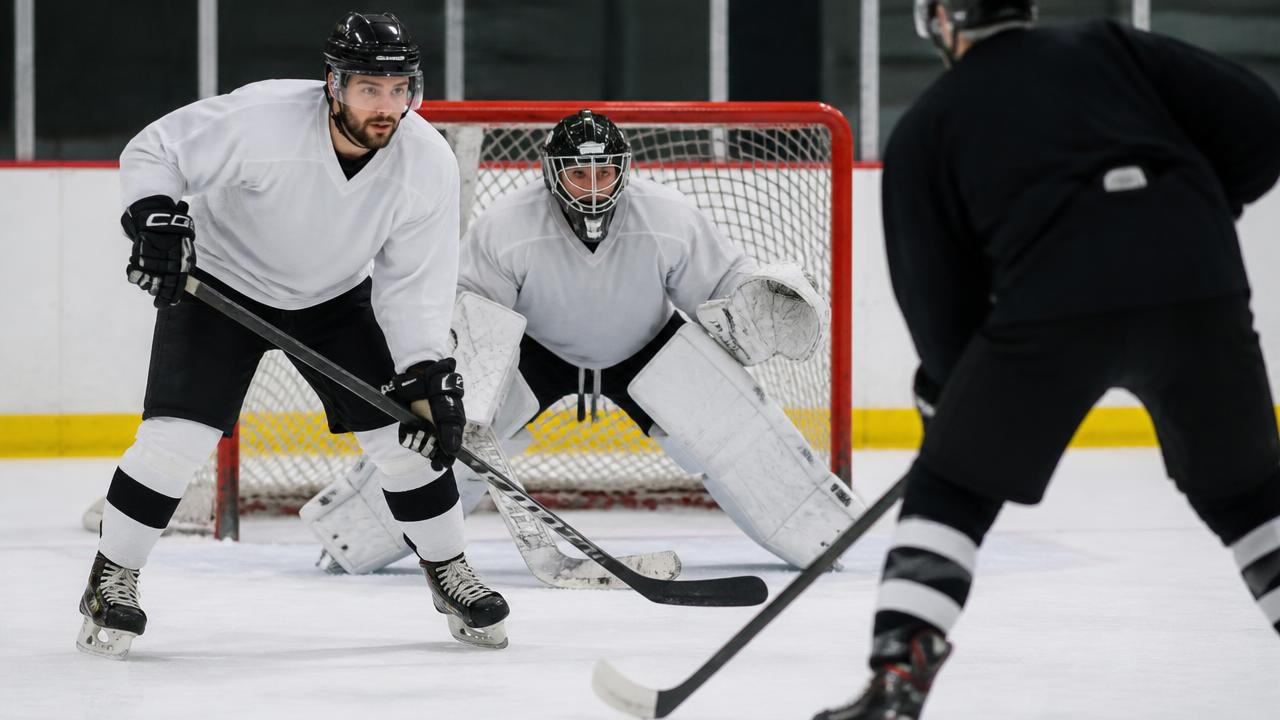
Forwards and defence
Five skaters are on the ice at a time: three forwards and two defencemen. The forwards are a centre and two wingers. The centre takes face-offs, covers the most ice, and is responsible for defensive support in the middle, which makes it the most demanding skating role on the team.
Wingers work the boards, drive the outside lanes and finish chances. Defencemen defend the blue line, break out the puck under pressure and increasingly join the attack — a mobile defenceman who can carry the puck out of his own zone solves the hardest problem in the sport, which is turning defence into attack in a confined space.
The distinction between the roles is looser than the names suggest, because all five skaters rotate through the same areas during a possession. What stays fixed is responsibility: the defencemen are the ones who must not be caught upfield when it turns over.
Lines, pairs and shifts
Hockey substitutes more heavily than any other major sport. A shift lasts well under a minute because the skating is anaerobic, and players change on the fly while play continues. Over a game a team runs four forward lines and three defensive pairs repeatedly through the ice.
Those units are built for purposes. The first line is the scoring group, the second provides secondary offence, the third is often a defensively responsible checking unit given the hardest opposing matchup, and the fourth plays short minutes at high energy.
Coaches try to control which of their lines faces which of the opponent's, and at home they get the last change after a stoppage, which is a real tactical advantage. Much of the away coach's evening is spent avoiding a matchup he cannot win.
The goaltender
No other player in team sport can single-handedly decide a game as often as a goaltender. A hot goaltender can carry a mediocre team through a playoff round; a struggling one can make a strong team look broken.
The role has become highly technical, built around positioning and angles rather than reflex saves. Modern goaltenders take away the parts of the net a shooter can see, which is why the shots that beat them are usually deflections, rebounds or shots taken while their view is blocked.
Teams carry two goaltenders and increasingly share the workload rather than riding one through eighty-plus games, because fatigue shows in a position where a few centimetres of positioning decides outcomes.