
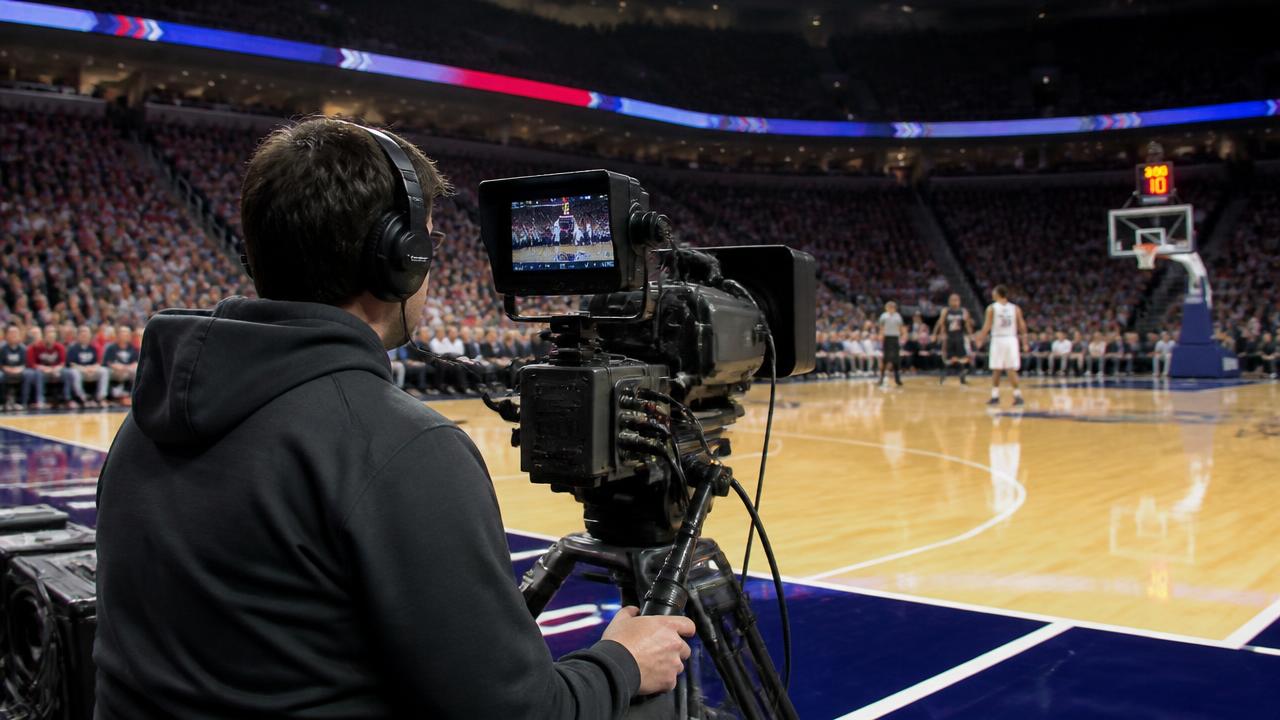
The camera is already an argument
The standard high sideline camera used for most broadcasts is chosen for legibility — it shows the ball and the basket clearly — but it compresses the depth of the floor, making a well-spaced offense look more crowded than it is and making a genuinely open shooter appear closer to a defender than the true distance. Viewers who only ever watch from this angle absorb a subtly distorted sense of how much space actually exists on an NBA floor.
This is not a criticism of broadcasters, who are solving a real problem of legibility for a casual audience, but it does mean that some tactical arguments — about spacing in particular — are genuinely easier to see live or from an elevated angle than they are from the couch, and it is worth knowing that the medium itself is shaping the analysis.
Replays are chosen, not given
A broadcast can only show a handful of replays per game, and the choice of which sequence to revisit — a highlight dunk rather than the defensive rotation that set it up, a controversial foul rather than the possession that preceded it — shapes what an audience remembers about the game far more than the box score does. Two viewers who watched the same broadcast can walk away with meaningfully different impressions of who controlled the flow of a game, purely because of which replays were selected.
This is worth remembering whenever a broadcast's chosen storyline hardens into consensus quickly. The story being told is a curated one, assembled in real time under time pressure, not a neutral transcript of everything that happened on the floor.
Commentary trains attention
Commentators cannot describe everything happening in a possession, so they select — usually the ball and whoever is nearest it — and that selection trains a viewer's eye over years of watching to follow the same things. Off-ball movement, defensive rotations and screening actions receive far less verbal attention than they deserve relative to how much they actually decide, simply because they are harder to narrate in real time.
A viewer who deliberately practices watching away from the ball for a portion of a game, ignoring the commentary's natural pull, will often notice far more about why a possession worked or failed than the broadcast itself communicated, which is less a criticism of any one broadcast team than an honest description of the format's limits.