
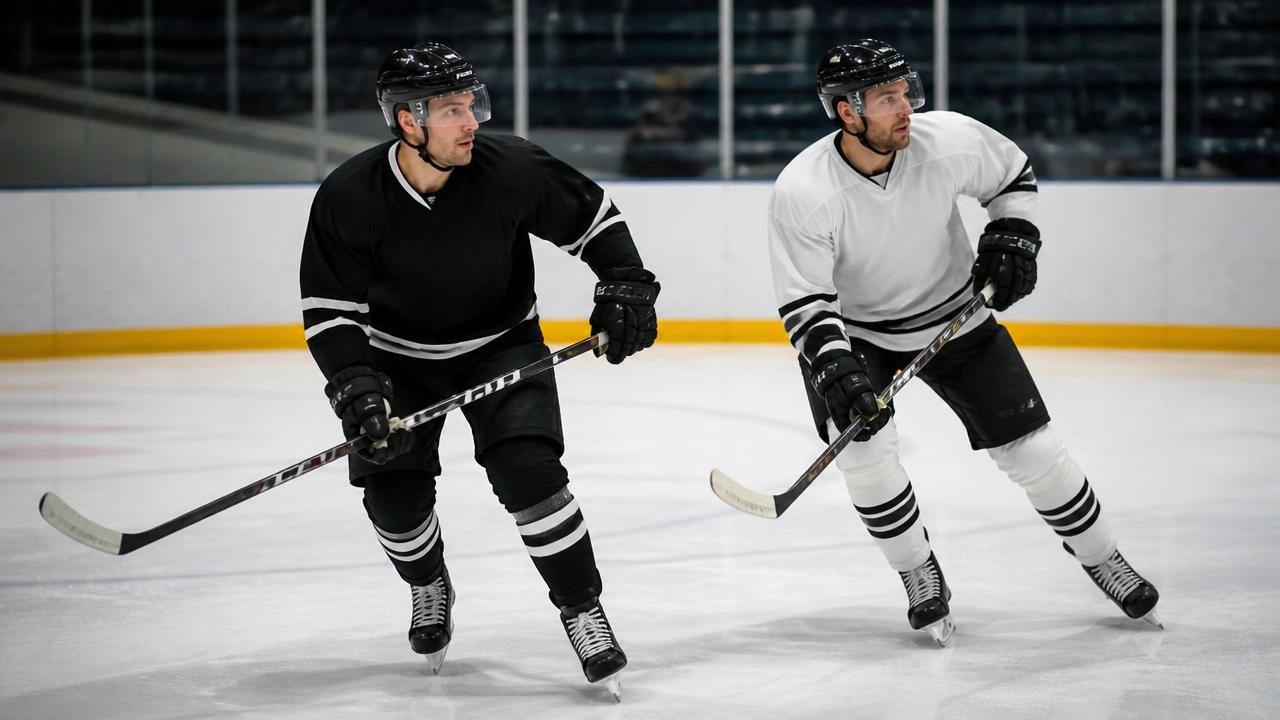
Three jobs, two players
In the defensive zone a pair has to cover the point, the corner battle and the front of the net without ever having enough bodies to do all three at once if the forwards are slow to help. Every pairing works out, consciously or not, a default answer for who takes which job when the play breaks down, and a pair without that answer looks disorganised even when both players are individually capable.
That default has to flex, too, because the same two players might face a low-to-high point shot one sequence and a net-front scramble the next. What separates a settled pairing from a new one is how quickly that flex happens without a conversation.
The labels hide the real work
Calling one player the puck-mover and the other the stay-at-home partner describes a tendency, not a fixed division of labour. Even a defensive specialist has to make an outlet pass under pressure sometimes, and even a mobile offensive defenceman has to win a net-front battle in his own end. The labels are useful shorthand and a poor guide to what actually happens on a given shift.
What the labels get right is that pairings tend to work best when the two players' instincts are complementary rather than identical — one more inclined to jump into the play, one more inclined to stay back and cover for it. Two players with the same instinct create gaps neither is inclined to fill.
Why continuity is worth protecting
A pair that has played hundreds of minutes together stops needing to communicate some decisions verbally, because each player has learned what the other tends to do under a given pressure. That saved half-second is often the difference between a clean breakout and a turnover, which is why coaches are often reluctant to break up a functioning pair even to chase a marginal upgrade on paper.
It is also why a new pairing frequently looks worse for weeks before it looks better. The individual talent has not changed; the shared instincts simply have not been built yet, and there is no shortcut to building them beyond playing minutes together.